Synthetic dyes are products of chemistry that began in the mid-19th century with the accidental discovery of the purple color “mauve.” Today, bright and inexpensive dyes are taken for granted, but it is important to understand their history, environmental impacts, and recent advances—along with how our studio works responsibly with chemical dyes.
Contents
- History of Synthetic Dyes
- Environmental & Health Impacts
- Modern Advances & Safety
- Our Approach at yamamayu
- Related Links
- FAQ
History of Synthetic Dyes
The story begins in 1856, when British chemist William Perkin accidentally synthesized “mauve” (mauveine). His discovery produced a vivid purple on silk and opened the era of industrial dyeing. Many traditional natural dyes were gradually replaced, and the synthetic dye industry—centered notably in Germany—expanded rapidly.
In short: Born from the 19th-century chemical revolution, synthetic dyes transformed the textile industry from the ground up.
Environmental & Health Impacts
Many synthetic dyes are slow to degrade and can harm ecosystems if discharged in wastewater. Some have contained heavy metals or formaldehyde, contributing to water pollution and potential human risks such as allergies or asthma.
In short: Because many synthetic dyes carry environmental loads and possible health concerns, careful use and treatment are essential.
Modern Advances & Safety
In recent years, “low-impact” synthetic dyes have been developed to reduce water and energy use and to improve safety and degradability. Research is also advancing on bio-based colorants produced by microorganisms.
Across consumer products—and in cosmetics and food uses—safety regulations have tightened, and dyes with carcinogenic concerns are being phased out.
In short: Technology and regulation are steadily reducing environmental burdens and toxicity risks associated with synthetic dyes.
Our Approach at yamamayu
At Yamamayu no Sato Dye & Weave Studio, we primarily use Irgalan® dyes. These are chromium-complex (metal-complex) acid dyes that provide clear, vibrant shades and excellent durability on protein fibers such as silk and wool.
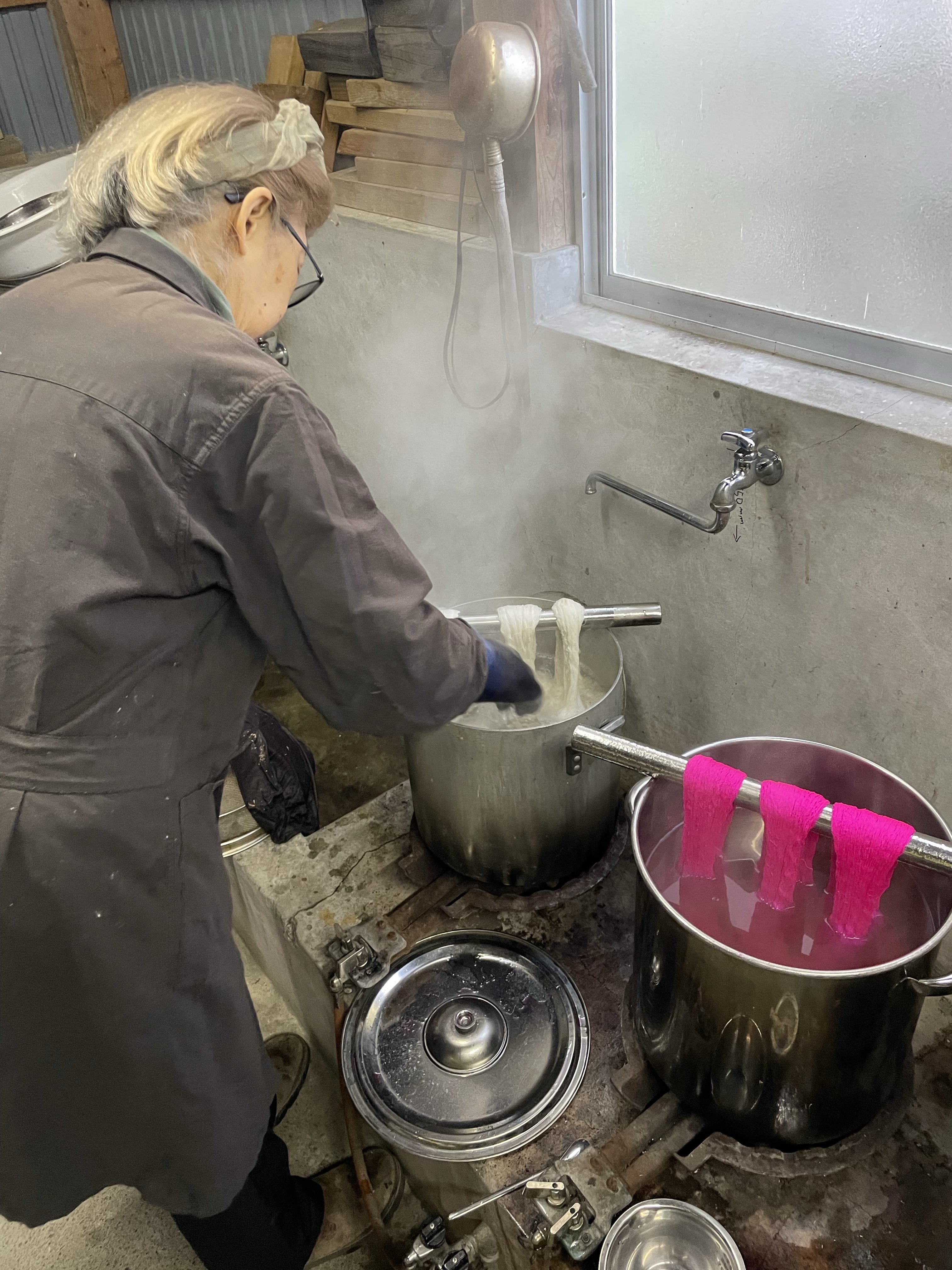

We choose between plant dyes and synthetic dyes according to the design and intended use of the cloth. When high lightfastness and wash durability are essential, we select Irgalan dyes.
From Hachioji to Our Yamanashi Studio
When our weaving mill in Hachioji was running, production was fully specialized: the yarn house supplied yarns, a separate workshop handled sizing, and we commissioned color from a dye house.
Since moving to Yamanashi, we handle both chemical and plant dyes ourselves and practice dyeing and weaving that consider color in relation to the specific material. Shifting from divided roles to an integrated process has given us greater freedom of expression.
In short: At Yamamayu no Sato, we combine chemical and natural dyes thoughtfully to achieve colors best suited to each fiber and design.
Related Links
FAQ
Q. Why did synthetic dyes become widespread?
A. They were less expensive and more vivid than many natural dyes, and they suited mass production.
Q. Are all modern dyes environmentally friendly?
A. No. Some dyes are still persistent or harmful; however, “low-impact” options and improved processes are increasingly available.
Q. How does your studio choose between dyes?
A. We use Irgalan for pieces requiring durability and color stability, and plant dyes where we want to highlight gentle, natural nuance.
 山まゆの里染織工房