
A customer who recently purchased a spindle asked us a question about how to spin yarn. They had raised silkworms with students in a special support class, made silk floss (mawata), and dyed it. To turn that silk floss into yarn, they bought a spindle. However, they wondered: since spinning yarn is difficult for lower elementary school children, is there an easier method?
Even for adults, spinning with a spindle can be challenging, and for children’s small hands it is even more difficult. It is also a time-consuming handwork process…
Unlike wool or cotton, silk fibers are made of long filaments. Because of this, silk floss can be simply pulled and stretched to become yarn without complex spinning.
A customer who recently purchased a spindle asked us a question about how to spin yarn. They had raised silkworms with students in a special support class, made silk floss (mawata), and dyed it. To turn that silk floss into yarn, they bought a spindle. However, they wondered: since spinning yarn is difficult for lower elementary school children, is there an easier method?
Even for adults, spinning with a spindle can be challenging, and for children’s small hands it is even more difficult. It is also a time-consuming handwork process…
Unlike wool or cotton, silk fibers are made of long filaments. Because of this, silk floss can be simply pulled and stretched to become yarn without complex spinning.
Gentle Yarn Spinning for Everyone
The method introduced here is designed so that children, including those with disabilities, can safely try it.
No needles or heat are required—just the sense of touch—so they can safely experience the moment when silk turns into yarn.
Of course, it is also enjoyable for adults as a simple way to feel the softness of silk floss without extra tools.
Broader Learning
Turning silk floss into yarn is not just about making thread—it is a vital first step from cocoon to textile.
Children can experience both the joy of creating yarn and the deeper lessons of “receiving life” and “appreciating nature’s gifts.”
It is also well-suited for classes and hands-on workshops.
Making It Accessible and Safe
- No time limits—each child can work at their own pace
- Only gentle handling of silk floss is needed, so even children with less strength can do it
- Placing white paper on the desk makes the yarn easier to see and helps concentration
Simple Way to Make Yarn from Silk Floss
1. First, fluff up the dried silk floss.

If you find firm spots in the fibers, use your fingertips to gently loosen them.

Fiber clumps can give character to the yarn, but they also make spinning harder. Fluffing them well makes the process easier.
2. Once fluffed, turn it over.

3. Hold the center of the silk floss and gently pull it outward.

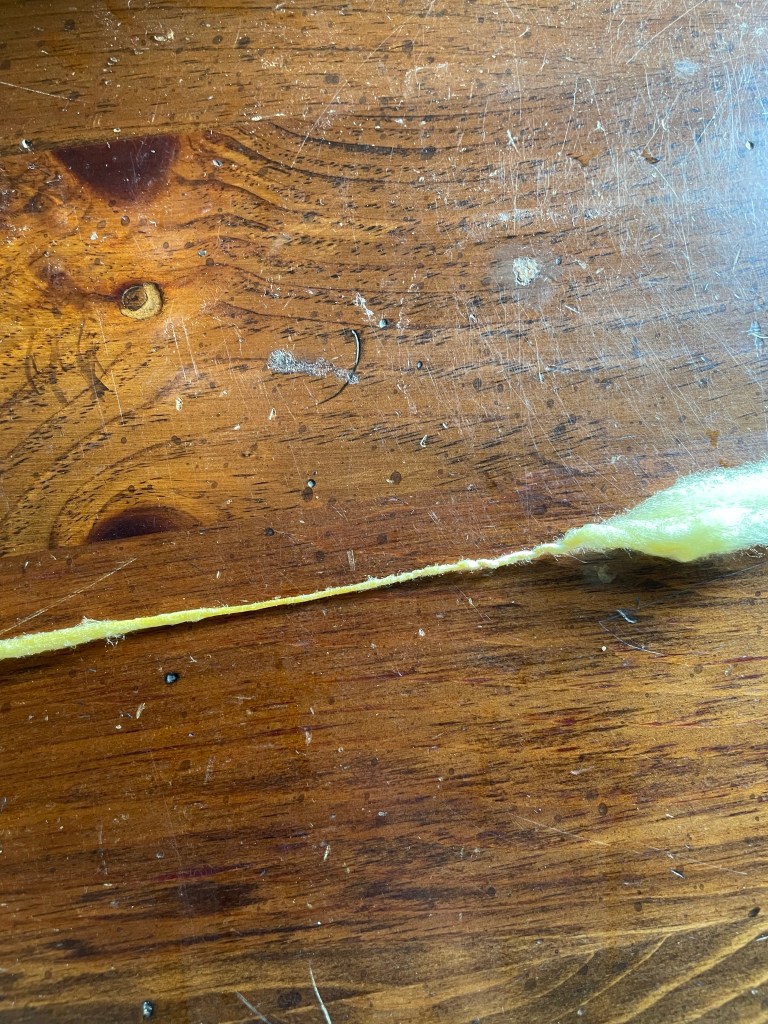
Pull smoothly until it reaches your desired thickness. This is the simplest form of yarn.

The fabric my daughter wove also uses this simple pulled yarn as weft threads.

The fluffy texture of silk floss really comes through.

You can also twist the pulled yarn by hand to make plied thread. Slightly damp hands make it easier.
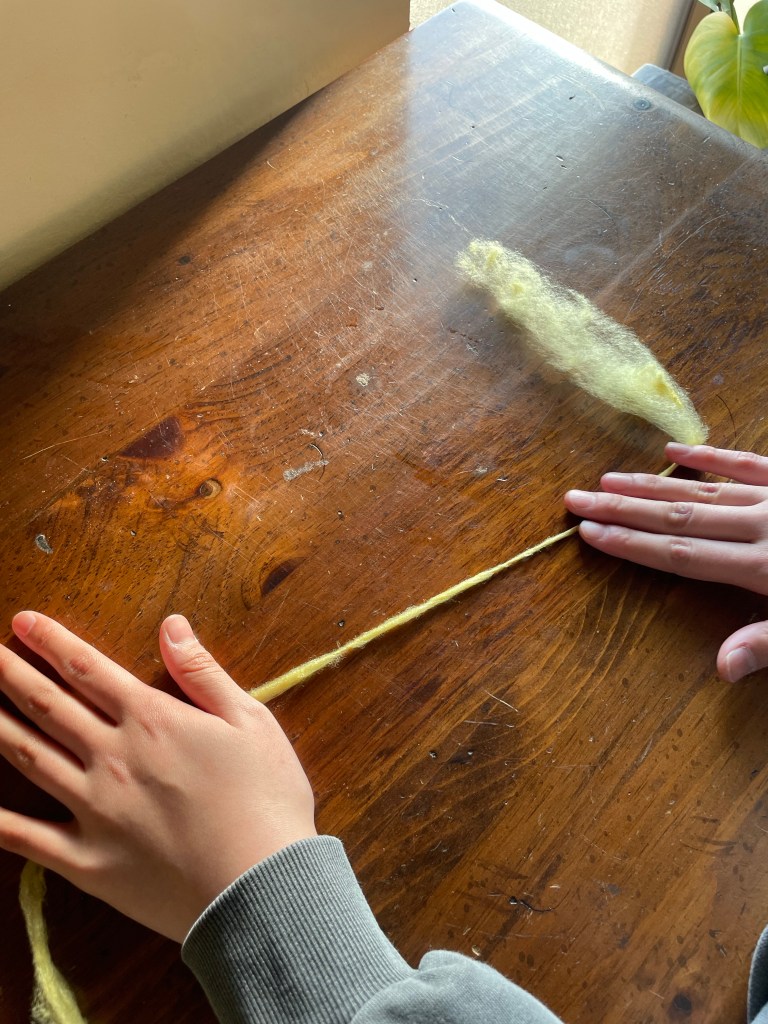
This produces yarns with varied thickness or fine smooth yarns.
Related Links
- Spinning Yarn from Silk Floss (Basic Guide)
- About Silk Floss (Basics)
- Examples of Works (Enjoying Silk Floss)
山まゆの里染織工房をもっと見る
購読すると最新の投稿がメールで送信されます。
 山まゆの里染織工房