
How to Boil Cocoons
Mawata begins with the quiet work of softening and opening the cocoon.
Making mawata begins with boiling the cocoon.
This step is a quiet preparation: it loosens the protein on the surface of the cocoon just enough to let the layers open more softly.
At yamamayu, the aim is always to avoid damaging the fiber. The cocoons are watched carefully, and the work proceeds as gently as possible.
The temperatures, timings, and concentrations written here are one example from the studio.
This process gently loosens the sericin on the surface of the cocoon so the layers can be opened. At yamamayu, the work is always guided by the condition of the cocoons, with as little strain on the fiber as possible.
Letting Water In

Dry cocoons tend to float, which makes the boiling uneven, so the first step is to let them absorb water well.
They are placed in lukewarm water and gently pressed down so that water can slowly reach the inside.
A rough guide is 30 to 60 minutes in warm water.
Sometimes they are left overnight from the day before.
What matters is not to hurry, but to wait until the cocoon begins to feel at ease with the water.
Dry cocoons tend to float. Letting water reach the inside first makes the later boiling more even and gentler.
Two Ways We Work
A Gentler Method
- Cocoons: 500 g
- Water: 10 L
- Baking soda: 60 g
- Powdered soap: 10 g
- 90–95°C for 60–90 minutes
- Turn the cocoons gently from time to time
Because it works with a milder alkali, this method tends to place less strain on the fiber and often leaves the cocoons fuller and softer.
A Shorter Method
- Cocoons: 500 g
- Water: 10 L
- Sodium carbonate (soda ash): 20 g
- Powdered soap: 10 g
- 95–98°C for 30–45 minutes
- Turn the cocoons gently from time to time
This method is faster, but because the alkali is somewhat stronger, it is important not to push the temperature or time too far.
In both methods, what matters most is not to overboil.
The goal is to bring the cocoon to a state where it can be opened — not to push it until it is damaged.
That final judgement appears directly in the texture of the mawata.
In both methods, the important thing is not to overdo it. The goal is to let the cocoon open, not to push it past its own softness.
Rinsing and Settling the Fiber
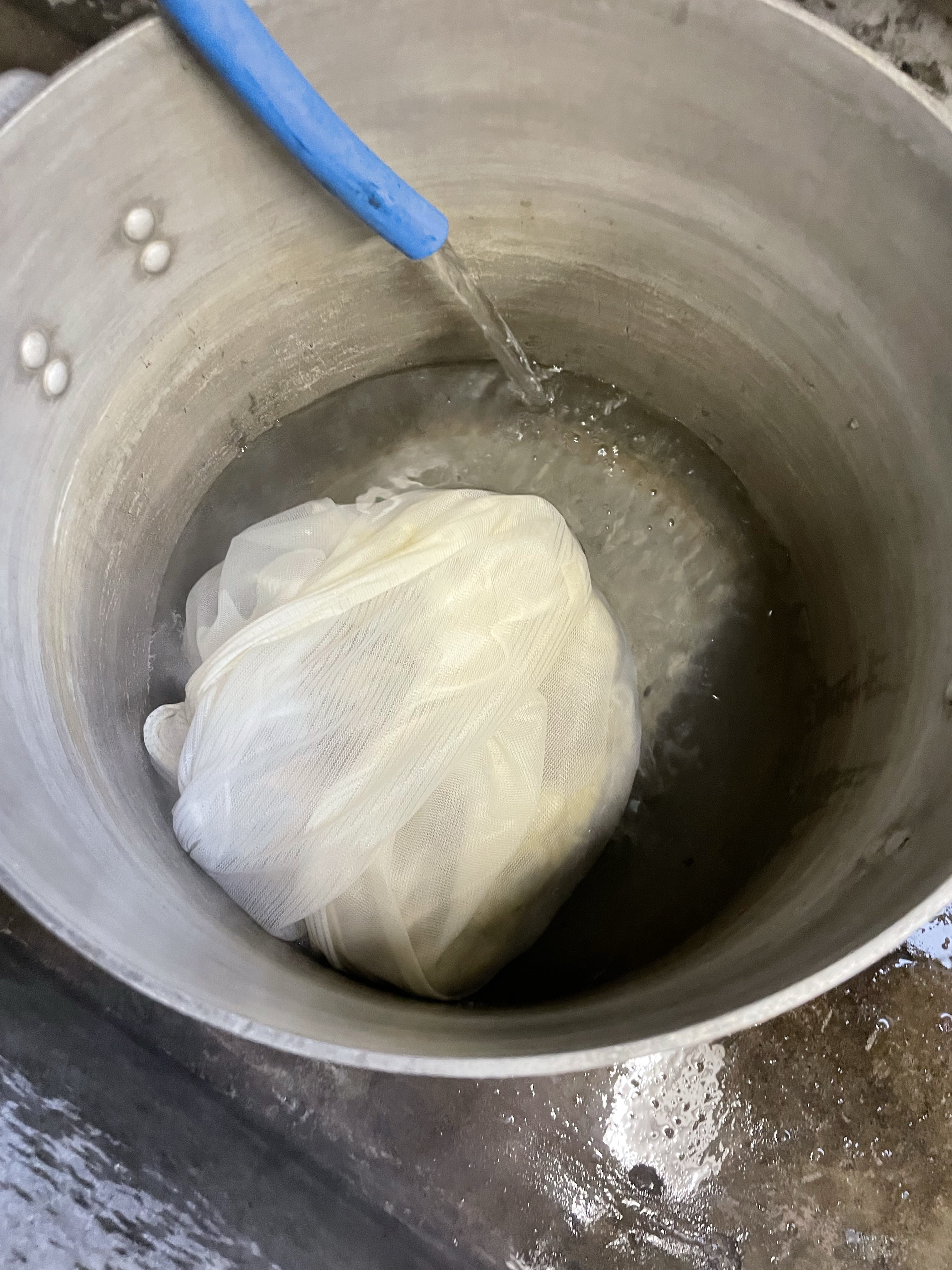
After boiling, the cocoons are rinsed thoroughly in warm water.
A rough guide is two rinses at 50–60°C for about 10–20 minutes each.
If needed, a short neutralizing rinse with citric acid or a small amount of vinegar can also be used.
Here again, the important thing is not to handle the cocoons harshly.
This is still part of the same work — helping the fiber settle quietly after boiling.
After boiling, the cocoons are rinsed thoroughly in warm water. If needed, a brief neutralizing rinse helps settle the fiber without harshness.
Knowing When It Is Ready
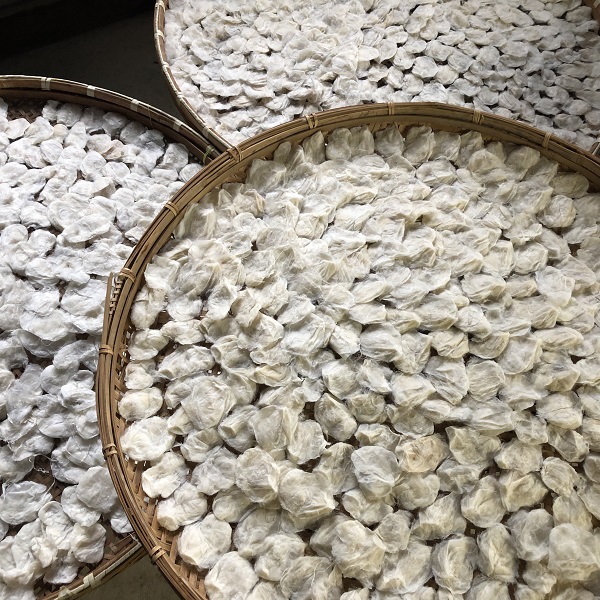
Take out a single cocoon and rinse it in water, then check how its layers begin to open.
If, when touched gently by the fingers, the layers begin to spread softly and thinly without resistance, it has reached the right state.
Temperature, time, and concentration all matter, but in the end the final judgement comes from the cocoon itself.
That is the kind of seeing the studio relies on.
The final judgement is not only about numbers, but about how the cocoon itself opens in the hand.
A Small Note on the Science
The surface of the cocoon contains a protein called sericin.
Heat and alkali loosen it, making the layers easier to open.
But if pushed too far, they can also place strain on fibroin, the inner silk itself, which is why temperature, time, and concentration must be handled with balance.
Heat and mild alkali loosen the sericin on the cocoon surface, but going too far can burden the silk itself. This is why gentle balance matters.
Safety and Care
Use heat-resistant gloves and an apron, and make sure the space is well ventilated.
Waste liquid should be diluted and handled in a way that reduces its burden, and pupae and cocoon residue should return to compost.
For us, the safety of the work and the way materials return to nature are not outside the making. They belong inside it.
Safety, waste, and what returns to the soil are all part of the making itself.
Continue Reading
From the boiling of the cocoon, mawata begins to move slowly toward cloth.
You may continue from here into thread, the studio, and the finished works.
 山まゆの里染織工房