Textiles at Yamamayu Studio are born from two kinds of silkworm “lives”: domesticated silkworms (Bombyx mori) and wild silkworms—tensan (Antheraea yamamai). Domesticated silkworms have lived alongside people; tensan are raised outdoors on oaks and related trees. Their food plants, ways of living, and even the look of their cocoons and threads differ. This page introduces the differences between the two.
Contents
- Two Profiles
- Thread Differences (Luster, Hand, Dye Affinity)
- Life Cycle & Seasons
- How We Use These Materials at yamamayu
- Learn More
- FAQ
Two Profiles
Domesticated Silkworm (Bombyx mori)

- Food plant: Mulberry
- Living style: Bred and reared alongside people. Adults (moths) have reduced mouthparts and scarcely feed or fly.
- Cocoon color: White to pale yellow
- Thread: Smooth and even; high reproducibility in dyeing
Tensan (Antheraea yamamai)

- Food plant: Leaves of Fagaceae such as sawtooth oak (Quercus acutissima) and konara oak (Q. serrata)
- Living style: Outdoor (or semi-reared). Known for producing yellow-green to green cocoons.
- Cocoon color: Yellow-green range (appears more yellow in darkness, greener in light)
- Thread: Tough with elastic body; reports note properties distinct from Bombyx mori, including resistance characteristics to chemicals and light.
* Tensan cocoon color varies with environment (yellower in the dark, greener under light). The yellow-green appearance is attributed to overlapping yellow pigments and blue-hued bilins.
Thread Differences (Luster, Hand, Dye Affinity)

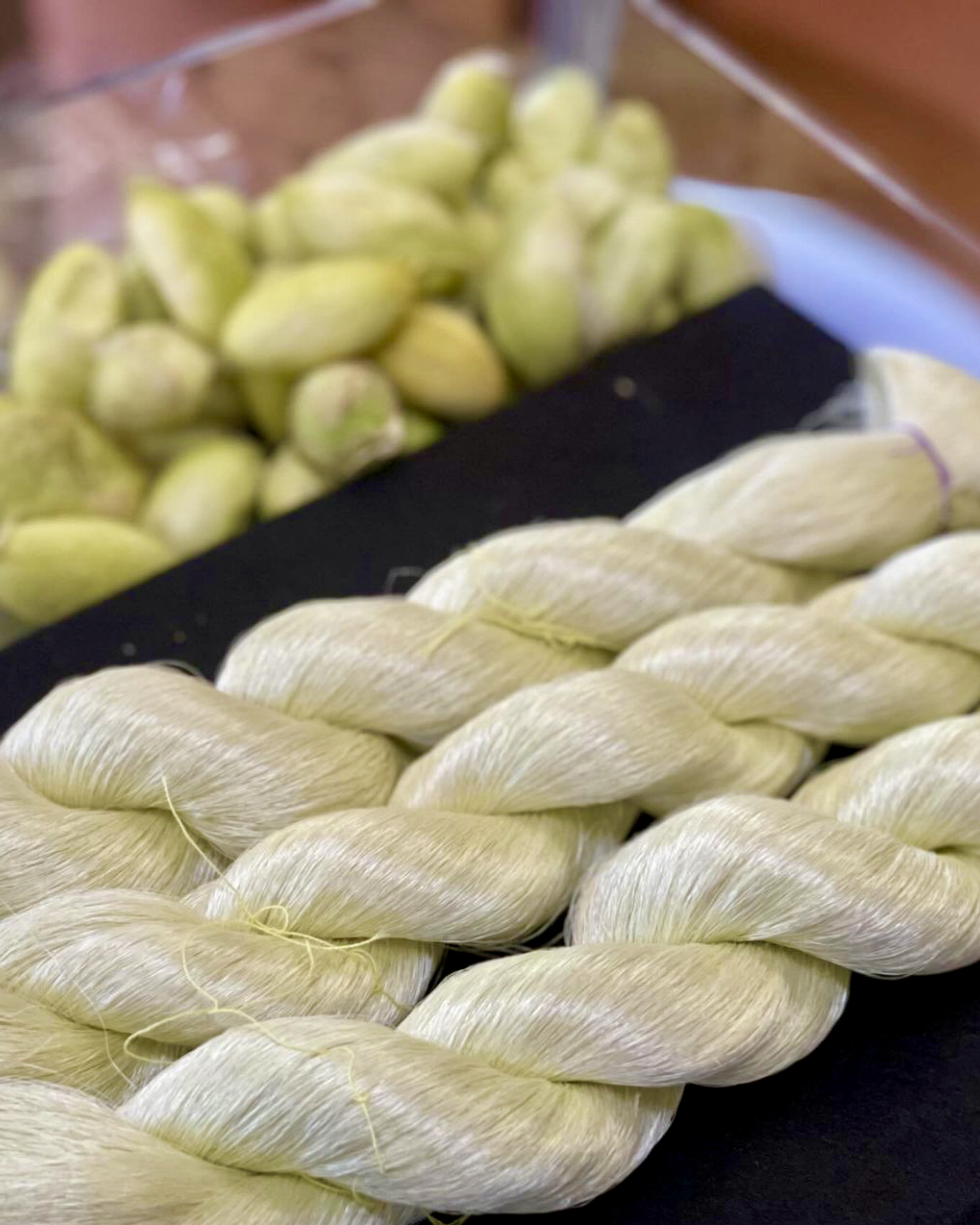
- Luster nuance: Bombyx mori shows a “mirror-smooth sheen,” while tensan has a glow that seems to rise from within. The former’s luster is partly due to refraction through its triangular fiber cross-section.
- Body & resilience: Tensan often exhibits notable thickness, compressive resilience, and chemical robustness—giving woven cloth a strong presence.
- Dye affinity: Bombyx mori dyes readily with excellent reproducibility. Tensan can be more reluctant to take dye, yet the raw material is famed as the “diamond of silk” for its inherent beauty.
In short: Bombyx mori = even and delicate; Tensan = wild grace and dignity. Both are “silk,” yet their personalities are distinct.
Life Cycle & Seasons
While Bombyx mori is reared stably under human care, tensan generally follows a univoltine (once-per-year) cycle on trees such as sawtooth oak (regional and management exceptions exist). Cocoons are formed by stitching leaves together on branches, and unperforated cocoons (those not opened by the emerging moth) can be reeled into continuous filament.
In short: Different living environments yield different cocoon colors and thread expressions—that is the “story of the material.”
How We Use These Materials at yamamayu
- Bombyx mori: We select fine reeled silk from a twisting mill in Hachioji and our own hand-spun silk-floss yarn, matching the expression we want.
- Tensan: We work with cocoons raised by friends in Iwate and from our own studio in Yamanashi, creating pieces with tensan reeled silk / hand-spun yarn. The natural yellow-green hue and supple strength are one-of-a-kind.
- Color design: Depending on design and use, we choose between plant-based dyes and selected chemical dyes (e.g., Irgalan)—leaning on chemistry where durability matters, and on plant color where gentle nuance is desired.
In short: “Honest, gentle material choices.” We respect both nature and human know-how to create textiles that are loved for a long time.
Learn More
FAQ
Q. What’s the single biggest difference between Bombyx mori and tensan?
A. Their food plants and living environments. Bombyx mori eats mulberry and lives indoors with people; tensan grows on trees such as sawtooth oak and produces yellow-green cocoons.
Q. Can tensan cocoons be reeled into raw silk (continuous filament)?
A. Yes, tensan cocoons can be reeled; however, a substantial portion cannot be reeled, which makes tensan filament extremely rare. (Unreelable parts are put to use as hand-spun floss yarn.)
Q. Which is better for everyday use?
A. Both are comfortable. Bombyx mori is smooth and easy-handling, while tensan has a full, dignified hand. Please choose according to use and preference.
Sidebar Column: Unperforated Cocoons & Why “Not All of It Reels”
Unperforated cocoons are those without the “exit hole” (perforation) made by the emerging moth. Because the filament remains unbroken, the cocoon thread can be reeled as a continuous filament. All reeled raw silk comes from such unperforated cocoons.
- However, the outermost layer (“floss”) and the very thin innermost layer are often difficult to reel as-is, so only part of the whole cocoon length is actually reelable. For tensan cocoons, roughly 30–40% may be unreelable.
- In reeling, brushing first removes the floss and finds the filament end; winding proceeds through the main layers and finishes at the innermost layer. Early on, breaks are common until a continuous filament is established; near the end, breaks increase again.
- Tensan reeling is more difficult than Bombyx mori, so pre-treatments (pre-boiling/degumming stage) may use agents such as sodium bisulfite, or more recently enzymes, to gently remove adherents and make reeling possible.
Studies report that without special pre-treatment (conventional methods), the recovery rate (portion actually reeled relative to cocoon shell weight) can be in the 60% range, while certain enzyme pre-treatments improved it to around ~70%. In practice, makers adapt to each cocoon’s character to “use the reelable portion to the fullest.” Unreelable parts at our studio are made into mawata and hand-spun—nothing is wasted.
 山まゆの里染織工房