Mawata begins as a soft, airy mass of silk floss.
By drawing out the fibers little by little and adding twist, it becomes thread.
At yamamayu, this hand-spun mawata thread is one of the foundations of our cloth.
Contents
- Preparing the Mawata
- How to Spin
- Using a Spinning Stick
- Tools
- Why Mawata Becomes Thread
- Helpful Tips
- FAQ
Preparing the Mawata
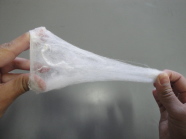
After cocoons are boiled and opened, the silk is spread into a soft, cotton-like form.
By gently stretching it with the pads of the fingers, mawata becomes easier to spin.

How to Spin
1. Draw Out the Fibers
Gently draw fibers from the center of the mawata, little by little.
A stronger pull makes a thicker thread; a lighter pull makes a finer one.
2. Add Twist
Hold one end of the thread and lightly twist as you draw it out.
This helps the fibers hold together and gives the thread strength.
The amount of twist also affects the feel of the finished yarn.
3. Wind It
Once the thread reaches a certain length, wind it onto a stick or tube.
Winding with steady tension helps later in weaving.
Using a Spinning Stick


Tools
- Winding stick or tube: a wooden stick or paper tube
- Twist-support tools: spindle, spinning wheel, or similar tools
Why Mawata Becomes Thread
Mawata is made of very long silk fibers layered together.
Unlike cotton, which is made of short fibers, mawata can be drawn out into thread almost as it is.
Adding a little twist gives it strength.
These long fibers also hold a great deal of air, which is why hand-spun mawata thread can feel light, warm, and softly textured.
Helpful Tips
- Draw the fibers out slowly and evenly
- Keep the air from getting too dry
- Do not pull too hard
- Allow a little unevenness—it gives the yarn character
FAQ
Q. How can I make the thickness more even?
A. Try to draw the fibers out with a steady rhythm and a similar amount of force.
Q. What if the thread breaks?
A. Overlap the ends slightly and twist again. Mawata connects surprisingly naturally.
Q. Do I need special tools?
A. Not always. It can begin with the hands alone, though tools can make the process easier later.
Q. What kinds of textiles does this yarn suit?
A. It works especially well for warm, expressive cloth such as stoles, kimono cloth, and small works.
Continue Reading
Learn more about the different threads used in the studio, read the Studio Journal, or continue to the finished works.
 山まゆの里染織工房